

Have you ever wondered what makes a story truly captivating?
It’s the plot—the backbone of any great narrative.
By understanding how plot works and mastering its key elements, you can craft compelling stories that keep readers hooked from beginning to end.
Let’s explore the six essential elements of plot, learn the difference between plot and story, and discover how to create an effective plot outline.
What is Plot?
Plot is the structured sequence of events that make up a story. It’s the backbone of your narrative, guiding the flow and pacing of the tale.
A well-crafted plot introduces characters, sets the stage, and presents a conflict that drives the story forward.
It builds tension through rising action, reaches a climax, and then moves towards a resolution. Plot is more than just a series of events—it’s the framework that connects them, ensuring your story is cohesive and engaging.
By understanding how plot works, you can create stories that captivate and resonate with your audience.
The 6 Elements of Plot
To create a compelling story, you need to understand its structure’s fundamental elements.
The plot works by guiding the narrative through a series of stages, each building on the last to create a cohesive and engaging experience.
By mastering these elements, you can craft stories that resonate with readers and keep them hooked from start to finish.
Each element has a unique role in developing the plot, building tension, and driving the narrative forward.
1. Exposition
The exposition sets the stage for your story. It introduces the main characters, establishes the setting, and provides necessary background information. This is where readers first meet the protagonists and understand their world.
The exposition lays the foundation for the plot, giving context to the forthcoming events. It’s essential for creating an immersive environment that engages the reader from the beginning.
By the end of this section, readers should clearly understand the story’s initial circumstances and the main characters’ motivations.
Related: 10 Key Parts of a Story
2. Conflict
Conflict is the driving force of any narrative. It presents the central problem or challenge that the characters must face. Without conflict, there’s no story to tell.
This element introduces the primary struggle, whether it’s an external battle against an antagonist or an internal struggle within the protagonist.
The conflict ignites the plot, creating tension and stakes that keep the reader invested. It propels the characters into action, forcing them to confront their deepest fears, desires, and limitations.
3. Rising Action
This element consists of a series of events that escalate the conflict and build tension. It’s the longest part of the plot, where characters face various obstacles and challenges.
Each event in the rising action should complicate the situation, leading to increased stakes and heightened suspense. This is where characters develop, relationships evolve, and subplots unfold.
The rising action is crucial for maintaining momentum, as it keeps readers engaged and eager to see how the characters will overcome the mounting difficulties.
4. Climax
The climax is the turning point and the most intense moment of the story. It’s where the primary conflict reaches its peak, and the protagonist must face the ultimate challenge. The climax is often marked by a decisive action, revelation, or confrontation that determines the story’s outcome.
It’s the moment of greatest tension, where everything hangs in the balance. The climax is pivotal, as it resolves the central conflict and sets the stage for the subsequent resolution.
5. Falling Action
Following the climax, the falling action shows the aftermath of the story’s peak. It depicts the consequences of the climax and begins to tie up loose ends. The falling action is where the tension starts to decrease, and the story moves towards a resolution.
Characters reflect on their experiences, relationships are mended or broken, and the world of the story begins to return to a state of normalcy. This phase helps to bridge the climax and the resolution, providing a smooth transition towards the conclusion.
6. Resolution (Denouement)
The resolution, or denouement, is the final part of the plot, where conflicts are resolved, and the story concludes. It’s the wrap-up that provides closure for the characters and the readers.
In this section, the protagonist has typically undergone significant growth or change, and the outcomes of their journey are revealed. The resolution answers lingering questions, resolves subplots, and leaves the audience with a sense of completion.
The satisfying end ties together all the narrative threads, ensuring the story feels complete and coherent.
What Is the Difference Between Plot and Story?
Understanding the distinction between plot and story is crucial for any writer. While the two terms are often used interchangeably, they refer to different aspects of a narrative.
- Story: The story encompasses the raw events and facts of a narrative. It’s the chronological sequence of what happens, including all characters, settings, and actions. Think of the story as the foundation—the basic material from which the plot is constructed. For example, a story can be summarized as “a young wizard discovers his magical heritage and battles an evil sorcerer.”
- Plot: The plot, on the other hand, is how those events are organized and presented to the audience. It’s the structured sequence of events that creates the framework of the narrative. The plot focuses on causality and the relationship between events, emphasizing how each incident leads to the next. In the wizard example, the plot details how the young wizard discovers his powers, faces challenges, forms alliances, and ultimately confronts the sorcerer in a climactic battle.
Key Differences:
- Structure vs. Content: The story is the content (what happens), while the plot is the structure (how it happens).
- Chronology vs. Causality: The story is typically a chronological sequence of events. The plot, however, may manipulate time (e.g., using flashbacks) to enhance the narrative’s impact.
- Purpose: The story provides a broad overview and essential elements of the narrative. The plot provides a specific path that engages the reader, creates tension, and builds towards the climax and resolution.
By understanding these differences, you can effectively use both elements to craft compelling and well-structured narratives. The story provides the raw material, and the plot shapes it into an engaging journey for your readers.
7 Common Plot Types and Examples
Plot types are the fundamental structures that shape stories across genres and cultures. By understanding these common plot types, you can recognize patterns in storytelling and harness them to create your own compelling narratives.
Each plot type follows a distinct path, offering unique opportunities for character development, conflict, and resolution. Here are seven of the most prevalent plot types and examples from well-known books to illustrate how they work.
1. Overcoming the Monster
Here, the hero faces a formidable antagonist or evil force, overcoming significant dangers and challenges to achieve victory.
Example: “Harry Potter and the Philosopher’s Stone” by J.K. Rowling
Harry Potter confronts and ultimately defeats Voldemort, who is trying to return to power by stealing the Philosopher’s Stone. Through bravery and quick thinking, Harry faces numerous challenges, from surviving a giant chess game to battling the dark wizard, showcasing the classic “overcoming the monster” narrative.
2. Rags to Riches
A protagonist rises from humble or disadvantaged beginnings to achieve great success, wealth, or happiness, often overcoming significant obstacles along the way.
Example: “Cinderella” by Charles Perrault
From a life of servitude under her cruel stepmother and stepsisters, Cinderella’s fortunes change dramatically. Her inherent kindness and magical intervention help her ascend to royalty, epitomizing the classic rags to riches narrative.
3. The Quest
A quest plot revolves around a protagonist’s journey to achieve a specific goal, involving travel and adventure with numerous trials and tribulations.
Example: “The Lord of the Rings” by J.R.R. Tolkien
Frodo Baggins’ mission to destroy the One Ring takes him on a perilous journey through Middle-earth. Along the way, he faces countless dangers and forges crucial alliances, embodying the essence of a quest plot.
4. Voyage and Return
In this plot type, a protagonist ventures into a strange land, encounters challenges and ultimately returns home with newfound wisdom or perspective.
Example: “Alice’s Adventures in Wonderland” by Lewis Carroll
Alice’s descent into Wonderland brings her face-to-face with a series of surreal and bizarre characters. Her journey through this fantastical realm and her eventual return home leave her with curious insights and a changed outlook on life.
5. Comedy
Comedy plots are characterized by humorous events and misunderstandings, leading to a happy resolution, often involving love or reconciliation.
Example: “Bridget Jones’s Diary” by Helen Fielding
Bridget Jones navigates the ups and downs of her love life and career with a blend of humor and mishaps. Her entertaining diary entries reveal a journey full of romantic entanglements and social blunders, culminating in a joyful and satisfying resolution.
6. Tragedy
A tragedy plot centers on the protagonist’s downfall, often resulting from a fatal flaw, moral weakness, or unavoidable circumstances. It typically ends in sorrow or disaster.
Example: “The Great Gatsby” by F. Scott Fitzgerald
Jay Gatsby’s relentless pursuit of wealth and his love for Daisy Buchanan ultimately lead to his tragic demise. His story highlights themes of ambition and the American Dream, ending in a poignant reflection on the consequences of his flawed desires.
7. Rebirth
In a rebirth plot, the protagonist undergoes significant transformation or redemption, emerging from a period of darkness or adversity with a renewed sense of purpose or identity.
Example: “A Christmas Carol” by Charles Dickens
The visit of three Christmas spirits prompts Ebenezer Scrooge’s journey from miserly curmudgeon to benevolent benefactor. Confronting his past, present, and future, Scrooge has a transformation that is a powerful example of the rebirth plot, demonstrating the possibility of redemption and change.
What is a Plot Diagram?
A plot diagram is a visual representation of a story’s narrative structure. It maps out the key elements, such as exposition, rising action, climax, falling action, and resolution, helping writers and readers understand the plot’s flow and progression.
How to Use a Plot Diagram in Writing
A plot diagram is an invaluable tool for writers because it provides a clear visual representation of the narrative structure. By outlining the key elements, writers can ensure their story maintains a coherent and engaging progression.
It helps organize ideas, identify potential gaps or inconsistencies, and keep the narrative focused. A plot diagram also aids in pacing the story effectively, ensuring that each part builds upon the previous one to create a compelling and satisfying read. Here are some ways to use one:
- Planning: Use the plot diagram as a blueprint for your story, ensuring you include all necessary elements and maintain a coherent structure.
- Organizing: Map out major events and turning points to visualize the narrative’s flow and maintain a logical sequence.
- Developing: Identify areas that need more detail or development, such as adding subplots or fleshing out character arcs.
- Editing: Review your plot diagram during revisions to check for consistency and ensure that each element effectively contributes to the overall story.
- Analyzing: Use the diagram to analyze and understand existing stories, helping you learn from their structure and apply similar techniques to your writing.
Examples of Plot Diagrams
1. “Harry Potter and the Sorcerer’s Stone” (Overcoming the Monster)
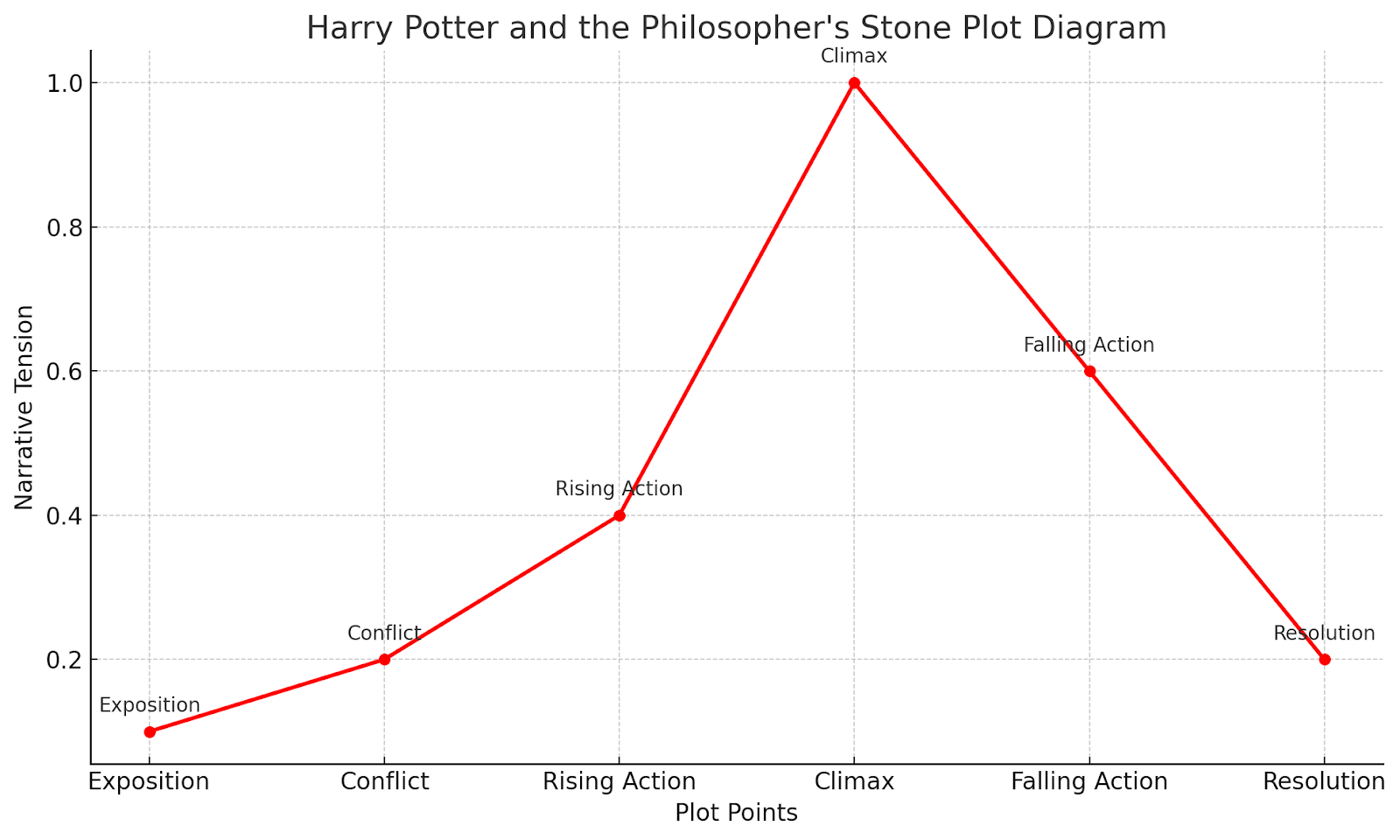
Explanation:
- Exposition: The story begins with Harry Potter living with his abusive aunt and uncle, unaware of his magical heritage.
- Conflict: Harry discovers he is a wizard and learns about Voldemort, the dark wizard who killed his parents and seeks immortality.
- Rising Action: Harry starts his education at Hogwarts, makes friends and enemies, and learns about the Philosopher’s Stone, which Voldemort seeks.
- Climax: The peak of the story occurs when Harry confronts Voldemort, who is trying to steal the Philosopher’s Stone.
- Falling Action: After the confrontation, Harry and his friends manage to thwart Voldemort’s plans.
- Resolution: The school year ends, and Harry returns to the Dursleys now with a better understanding of his identity and future challenges.
2. “The Great Gatsby” (Tragedy)

Explanation:
- Exposition: Introduces Nick Carraway, who moves to West Egg and meets his mysterious neighbor, Jay Gatsby.
- Conflict: Gatsby’s obsessive love for Daisy Buchanan and his desire to recreate the past drive the narrative.
- Rising Action: Gatsby throws lavish parties, hoping Daisy will attend. Eventually, with Nick’s help, they rekindle their romance.
- Climax: The confrontation between Gatsby and Tom Buchanan reveals Gatsby’s past and his unrealistic dreams.
- Falling Action: Daisy retreats to Tom, and Gatsby’s dream unravels as he waits for a call from her that never comes.
- Resolution: Gatsby is killed by George Wilson, who believes Gatsby was driving the car that killed his wife, Myrtle. Nick reflects on the moral decay of the society around him.
3. “Alice’s Adventures in Wonderland” (Voyage and Return)

Explanation:
- Exposition: Alice, a curious girl, is introduced, following a white rabbit down a rabbit hole.
- Conflict: Alice finds herself in a strange and whimsical world where nothing is as it seems.
- Rising Action: Alice encounters various odd characters and experiences bizarre events, each more curious than the last.
- Climax: The trial scene where the Queen of Hearts accuses the Knave of Hearts of stealing tarts. Alice challenges the absurdity of the court.
- Falling Action: Alice grows to her full size and denounces the court, causing chaos.
- Resolution: Alice wakes up to find it was all a dream, reflecting on her strange adventure.
Can a Story Have More Than One Plot?
Yes, a story can have more than one plot. These additional plots, known as subplots or parallel plots, can enhance the depth and complexity of the narrative, offering different perspectives and enriching the overall reading experience.
Subplots
Subplots are secondary storylines that run parallel to the main plot. They typically involve supporting characters and are designed to complement or contrast with the main narrative. Subplots can provide additional context, develop characters further, and introduce new conflicts or themes that enrich the primary storyline.
- Example: In J.K. Rowling’s “Harry Potter and the Philosopher’s Stone,” the main plot revolves around Harry’s discovery of his magical heritage and his battle against Voldemort. A significant subplot involves Hermione’s and Ron’s personal growth and their developing friendship with Harry. This subplot enhances the main narrative by showing how the trio’s bond strengthens as they face various challenges together.
Parallel Plots
Parallel plots are two or more storylines that occur simultaneously but may intersect at crucial points. These plots often involve different sets of characters and settings, but they are thematically linked. Parallel plots can provide multiple viewpoints, highlight contrasts, or build suspense as the reader anticipates how the plots will converge.
- Example: In Charles Dickens’s “A Tale of Two Cities,” the parallel plots of Charles Darnay and Sydney Carton unfold against the backdrop of the French Revolution. Darnay’s story of love and redemption intersects with Carton’s tale of sacrifice, culminating in Carton’s ultimate act of heroism. The parallel plots enhance the narrative by providing contrasting character arcs and deepening the themes of sacrifice and resurrection.
Enhancing the Story
Multiple plots can significantly enhance a story by adding layers of complexity and providing a richer, more immersive experience for the reader. They allow for the exploration of various themes and character dynamics that might not be possible within a single plot structure. By weaving together subplots and parallel plots, writers can create a more intricate and engaging narrative.
- Example: In George R.R. Martin’s “A Game of Thrones,” multiple plots involving different characters and locations unfold simultaneously. The Stark family’s struggles in the North, Daenerys Targaryen’s rise to power in the East, and the political machinations in King’s Landing are all interconnected. These multiple plots provide a vast and detailed tapestry that enhances the depth and complexity of the story.
Having more than one plot in a story can offer numerous benefits, from deepening character development to enriching thematic exploration. Subplots and parallel plots are effective tools for adding layers of meaning and enhancing the reader’s engagement with the narrative.
The Importance of Plot in Different Genres
Understanding how plot functions in various genres can help writers tailor their narratives to fit genre conventions while still crafting unique stories.
Mystery/Thriller
Mystery and thriller genres thrive on suspense and unexpected twists. The plots are typically fast-paced and tightly woven, with clues and red herrings carefully placed to keep readers guessing.
- Building Suspense: Utilize cliffhangers and tension-filled scenes to keep the audience on edge.
- Delivering a Twist: Crafting a surprising yet plausible twist can enhance the plot’s impact.
- Example: In “Gone Girl” by Gillian Flynn, the plot twists reveal deeper layers of the characters’ motivations, keeping readers engaged until the end.
Romance
Romantic plots focus on the development of relationships, often highlighting emotional growth and conflict resolution. The plot centers around the protagonists’ journey to find love, with various obstacles and misunderstandings along the way.
- Relationship Development: Emphasize the progression of the protagonists’ relationship through shared experiences and emotional moments.
- Emotional Arcs: Highlight the characters’ personal growth and the emotional stakes of their relationship.
- Example: In “Pride and Prejudice” by Jane Austen, the evolving relationship between Elizabeth Bennet and Mr. Darcy is central to the plot, showcasing their growth and eventual understanding.
Science Fiction/Fantasy
In science fiction and fantasy, world-building is integral to the plot. These genres often involve complex plots with multiple characters and subplots, where the setting plays a crucial role in shaping the narrative.
- World-Building: Integrate the unique elements of your fictional world into the plot to create a believable and immersive experience.
- Intertwining Plots: Weave together various subplots to enhance the main storyline and add depth.
- Example: In “The Hobbit” by J.R.R. Tolkien, the plot intertwines Bilbo’s personal journey with the larger quest to reclaim the Lonely Mountain, all within a richly developed fantasy world.
Techniques for Developing Strong Plots
Developing a robust plot requires employing various literary techniques that enhance narrative engagement and coherence. Here are some key strategies:
Foreshadowing
This technique involves planting subtle hints about future events, building anticipation and tension. It keeps readers curious and creates a sense of inevitability. Using symbols, dialogue, or minor events to suggest what might happen later creates suspense that makes readers look forward to significant plot developments.
- An excellent example of foreshadowing is in “Of Mice and Men” by John Steinbeck, where the hints about the tragic ending create a sense of impending doom.
Flashbacks
Providing an essential backstory enriches the present narrative by revealing past events shaping characters and plot. Flashbacks can explain a character’s motivations or past experiences influencing the current plot. This deepens the reader’s understanding of the characters and their actions by showing critical moments from their past.
- Harper Lee effectively uses this in “To Kill a Mockingbird,” where flashbacks to Scout’s childhood provide context and depth to the main storyline.
Pacing
Pacing is crucial for maintaining reader interest. Balancing fast-paced action scenes with slower, reflective moments creates a dynamic and engaging narrative. When you alternate between action-packed scenes and slower, introspective moments, you can maintain a rhythmic flow, ensuring the plot progresses at a pace that keeps readers engaged but not overwhelmed.
- Dan Brown’s “The Da Vinci Code” exemplifies effective pacing with its mix of fast-paced chases and slower, puzzle-solving scenes that keep the plot engaging.
Common Plot Pitfalls to Avoid
Even experienced writers can encounter common plot pitfalls that undermine their narratives. Here are some to watch out for:
Predictability can disengage readers. Strive for originality and surprise to keep your audience invested. Avoiding clichés and steering clear of overused tropes and plot twists that readers can foresee is essential. Introducing unexpected developments that are still believable within the story’s context can create engaging narratives. Chuck Palahniuk’s “Fight Club” achieves this with a major plot twist that is both surprising and integral to the story, keeping readers captivated.
Plot Holes can break the story’s internal logic, confusing readers and undermining the narrative’s credibility. Ensuring consistency means double-checking that all plot elements make sense and fit together logically. Maintaining continuity involves paying attention to details that ensure the story remains coherent from start to finish. J.K. Rowling’s “Harry Potter and the Prisoner of Azkaban” is a good example of avoiding plot holes, as careful plotting ensures that time travel elements fit seamlessly into the narrative without contradictions.
Underdeveloped subplots should enhance the main plot, not detract from it. Ensure subplots are well-integrated and meaningful. Integrating subplots involves connecting them to the main narrative and ensuring they contribute to character development or theme. Adding value through subplots allows the exploration of additional aspects of characters or the world that the main plot cannot fully address. Victor Hugo’s “Les Misérables” effectively uses subplots involving characters like Fantine and Eponine to enrich the main narrative and themes of justice and redemption.
Final Thoughts
By understanding and applying the six elements of plot, you’ll be able to craft stories that truly captivate your readers. Embrace these techniques, avoid common pitfalls, and don’t be afraid to revise and refine. With these tools, your storytelling will shine and leave a lasting impact. Happy writing!