
So, you have a finished book, and you’re wanting to publish a paperback (or hardback) option for your readers.
But what size should you choose for it?
Should you go with the average book size for your genre, or should you base your decision on your book’s word count and go with the size that will cost the least to print?
For example, maybe you were thinking of 5.5” by 8.5”, but the page count would be so high, you’d pay over a dollar more per copy (according to KDP’s printing cost calculator) than you would if you chose a 6” by 9” trim size. So, you’d have to set the price higher to get the same amount in royalties.
Standard book sizes for the publishing industry give you the best clue as to how to move forward on this. But you’ll also want to consider the following:
- Typical book sizes for your genre
- The book size you particularly like for books in your chosen genre
- Distribution options for each book size
- The maximum price you want to charge for each copy
- The minimum royalty you want to earn from each copy
If the average book in your genre, for example, costs under $10, you may want to choose a book size that ensures you’ll earn at least $2 per copy at this price. Once you’ve determined the page count for each trim size, you can use those values to calculate the printing costs for the options you’re considering.
Also, if you choose the “extended distribution” option with KDP, make sure your price is well above the cost of printing and distribution. You’ll have to set the price a few dollars higher than you would for standard (Amazon) distribution.
With Ingram Spark, you’ll also input a wholesale discount for booksellers (55% is a standard minimum if you want to see your book on bookstore shelves). To calculate price per book and your royalty (“publisher compensation”), use the calculator on their website.
But there’s more to choosing the right book size than calculating your royalties.
Why Size Matters
The trim size is one of the main determining factors for your book’s page count. Other factors include margins, font type and size, and line spacing.
Not only do you want your book to fit comfortably into your readers’ hands, but you also want it to look great on their shelves. The book’s cover will have plenty to do with this, but the size will determine how well your book fits on your readers’ shelves, how much horizontal shelf space it will take up, and how it will look with the books next to it.

You’ll also want to ensure that your book’s typeface is easy on your readers’ eyes. Generally speaking, a book-sized 4” by 7” is going to have a smaller typeface than one sized 6” by 9”. If you struggle with mass market paperbacks for this reason, many of your ideal readers will, too.
Other than these concerns, you’ll want to keep the following in mind:
- Industry standards – so your book will look as professional as possible
- Genre standards – so readers of that genre will immediately recognize your book as a legitimate and worthy addition
If your book size deviates noticeably from the standard paperback size for the publishing industry — or for your book’s genre — it will stand out, but not necessarily in a good way.
Conformity isn’t always a bad thing. And in this case, conforming to industry and genre norms can only improve your book’s chances of selling widely and ending up on bookstore shelves.
Let your readers find out how unique your book is after they’ve bought it.
What is book trim size?
Trim size is the publishing term for book size — specifically the dimensions used for each page of your book. The publisher mechanically “trims” the pages to make sure they’ll all be uniform in size.
Standard book trim sizes are the book sizes most commonly used in the publishing industry for books of a particular genre or type.
It helps to spend some time in a library (and this could be your home library) or a bookstore with a measuring tape and to measure some of the books in your book’s genre. See which sizes feel the best in your hands and check each book’s page count to get an even better idea of how your book would feel if it had the same trim size and page count.
Check the following, too:
- Font size and readability (some fonts will be larger and more readable at 12 pt than others; compare Libre Baskerville with Times New Roman, for example)
- The sheen of the cover (is it dull/matte or shiny?)
- Margins: top, bottom, and outside (measure those, too)
The gutter margin is added to the inside margin to make room for the binding. The thicker the book, the larger the gutter, so your words don’t end up running into the inside crease (gutter) between the pages.
Many DIY book formatters make the mistake of making their margins too narrow in order to decrease page count — thereby lowering the cost per book. But think about your reader when setting your book margins. If you want them to finish reading your book, make the reading experience as enjoyable as you possibly can.
Look at the books you have (or might be examining at a bookstore) and see how the added white space at the margins makes the page easier on the eyes. A little extra white space goes a long way.

Top and bottom margins vary, depending on whether your book will have running headers or footers on each page — and on where the page numbers will go. Look through some bestselling paperbacks to see how much space they put at top and bottom and how they format their headers and footers (if they have them).
When it comes to selling more books, it pays to imitate the best examples in the publishing industry. Ask yourself what you notice immediately when looking through one of them:
- Does it feel as though they tried to cram too much text on each page?
- Are the headers or footers distracting?
- Could I spend hours reading this typeface?
- Do the font size and style fit the book size? Or does it look larger or smaller than necessary?
While you’re there doing research, you can indulge in a little creative visualization.
Picture yourself placing your own book of that trim size and thickness on your shelf at home. Picture others doing the same — or curling up in a comfy chair with your book. Go ahead and take a deep breath while you savor the moment. I’ll wait.
Then, when you find the trim size that you want for your book, take one of the following steps:
- Format your book — in Word, InDesign, or another program — with your chosen page size, margins, fonts and font sizes (for body text, chapter titles, and section headers).
- Pay a professional formatter to help you design a beautiful book interior, using the chosen trim size and other stylistic details. Some indie publishing outfits, like Archangel Ink, have in-house interior book designers who will carefully choose the right fonts, font sizes, margins, and other details to fit your book’s message, as well as its genre.
What are the standard book sizes in publishing on KDP?
Industry Definitions of Trim Size
Mass-market Paperbacks
The standard size for a mass market paperback is around 4.25” by 6.87”. Books at this size usually come with a tiny typeface and spine flexibility ranging from minimal to moderate.
KDP standard book sizes include most standard book dimensions, but they exclude the mass market paperback size. KDP print book sizes, then, range from the smallest trade paperback (5” by 8”) to the largest (8.5” by 11”).
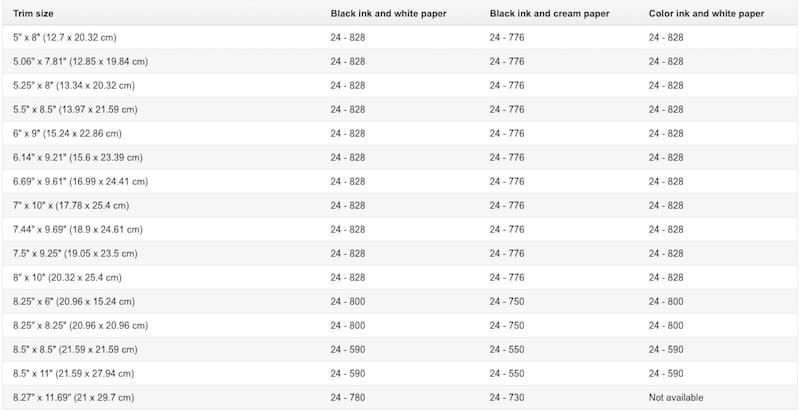
If you’re hoping to convince local store owners to add your novel to their mass market book racks, consider Ingram Spark‘s print on demand service, which offers the following print book sizes under 5” by 8.
- 4” by 6”
- 4” by 7”
- 4.25” by 7”
- 4.37” by 7”
- 4.72 by 7.48”
Trade Paperbacks
These are the most common book sizes for most fiction and nonfiction books. The two most popular sizes in the U.S. are 5.5” by 8.5” (“digest”) and 6” by 9”.
Hardcover
KDP doesn’t print hardcover books, but Ingram Spark offers a wide range of hardcover print book options, running from 5” by 8” to 8.5” by 11”.
List of Standard Book Sizes in Traditional Publishing
Fiction (Novel)
- 4.25” by 6.87” (mass market)
- 5” by 8” (trade)
- 5.25” by 8” (trade)
- 5.5” by 8.5” (trade/”digest”)
- 6” by 9”
Novella
- 5” by 8”
Children’s
- 7.5” by 7.5”
- 7” by 8”
- 10” by 8”
Nonfiction
- 5.5” by 8.5” (trade/”digest”)
- 6” by 9”
- 7” by 10”
Memoir
- 5.25” by 8”
- 5.5” by 8.5”
Textbooks
- 6” by 9”
- 7” by 10”
- 8.5” by 11”
Photography (including “Coffee Table Books”)
- Whatever you like — up to 8.5” by 11” (for color)
Ingram Spark and KDP Print will both print books as large as 8.5” by 11”. Ingram Spark will also print hardcover books up to that size. KDP Print has an 8.27” by 11.69” paperback option, but only for black and white.
For more options, check out the book sizes chart on KDP or on Ingram Spark.
Considerations in Choosing the Best Book Size
By now, you know that the correlation between page count and the cost of printing isn’t the only factor worth considering when choosing the best trim size for your book:
In other words, objective criteria aren’t the only ones that matter.
Once you calculate the page count at different trim sizes for your genre, go to a bookstore and look for books of the same size and thickness. Which feels best in your own hands? Which do you think will suit your book best?
And do you prefer a matte cover for the size you’ve chosen — or a shinier one? Take a look at other book covers to see what appeals to you more and try to gauge whether your book’s cover design would look best with or without a reflective sheen.
Going Wide?
Whether you’ll see your book on bookstore shelves will depend more on your choice of print-on-demand service. Most independent booksellers don’t look kindly on Amazon; they’re far more likely to accept a book printed using Ingram Spark.
That’s probably why Kindle Direct Printing (KDP) doesn’t bother with mass-market paperback sizes.
Unusual or non-standard trim sizes can also limit your distribution options. So, you’ll want to consider that when tempted to choose a custom sizing for your book.
Finally, do you have a price point you’d like to stick with — one that fits nicely with genre norms? If so, it pays to calculate your royalties based on your book’s trim size and page count.
You’ll pay about a dollar less for a 6” by 9” book with 200 pages than you would for a 5.5” by 8.5” copy of the same book with around 300 pages. And unless you raise the price to absorb the difference, you’ll pay for it with a significant drop in royalty income.
And honestly, if someone would pay $13 for your paperback book, they’d probably pay $15 without thinking twice about it.
More Related Articles:
252 Of The Best Writing Prompts For All Writers
How To Create A Back Cover Blurb That Sells Your Book
Did this list of book sizes help you? Spread the love.
If you found value in this article, would you please pass it on to help fellow authors choose the right trim sizes for their books? You might think this is pretty basic and that other authors know more about this than you do, but if you took the time to read this, I guarantee you someone else out there will find it helpful.
Plus, just sharing articles like this will help your fellow writers out there feel less alone and more widely supported and encouraged. You’ll help clear up some of the confusion that surrounds self-publishing. You might just make somebody’s day better by getting them that much closer to becoming a published author of a stunning, new paperback.

May your thoughtfulness and creativity influence everything else you do today.